The real pain today
Anyone can say yes. An exception to an accessibility rule is granted by whoever is senior and in a hurry.
You are asked last. A component reaches stable before anyone asked whether it works with a keyboard.
Absence becomes a loophole. When you are away, decisions are made by whoever covers your inbox.
Your week with Loom
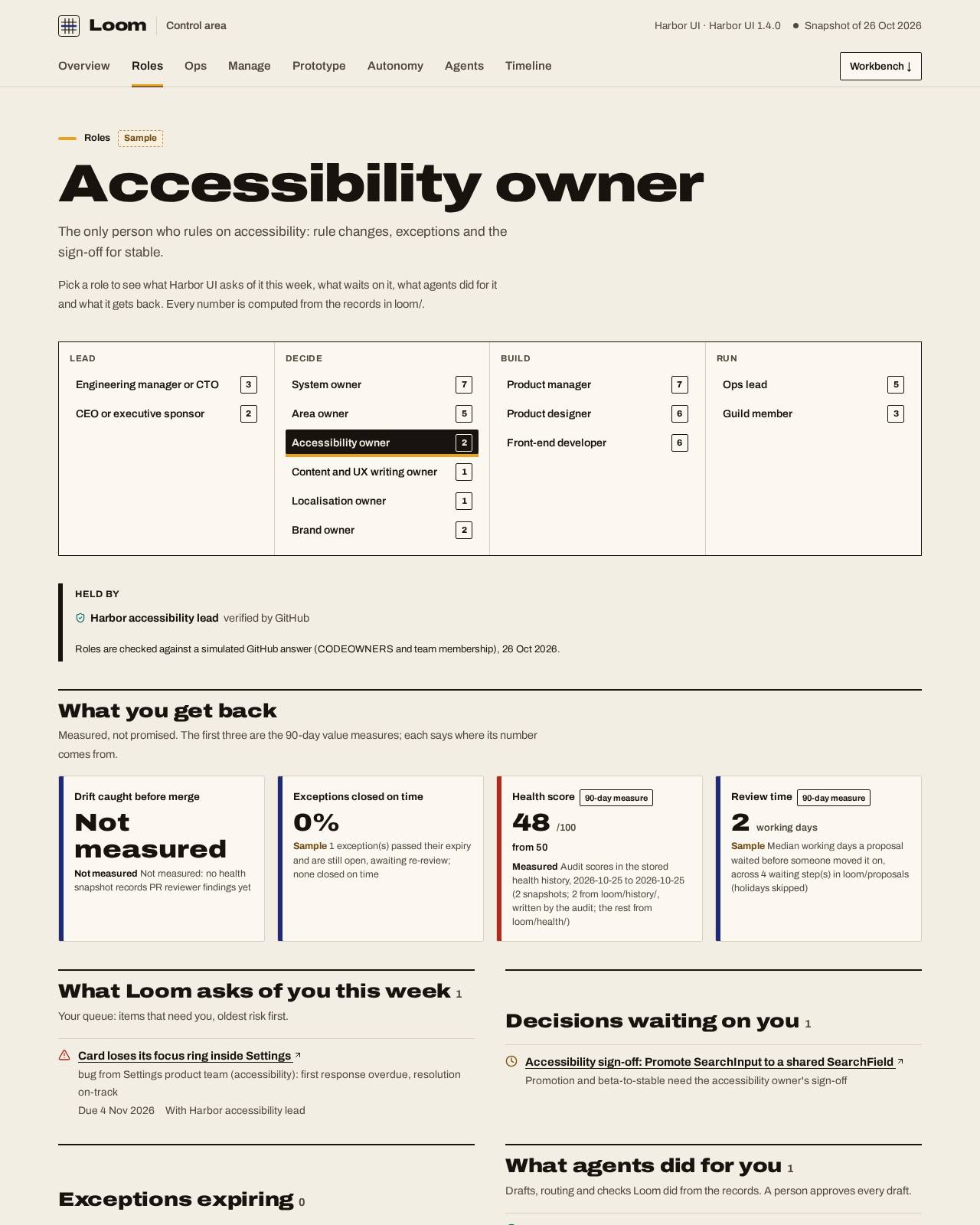
Monday. Your home lists the sign-offs waiting on you: promotions to a shared layer and moves to stable need your approval. See the accessibility owner's home
Tuesday. A team asks for an exception to an accessibility rule. Only you may grant it, even over the system owner, and it lasts at most 90 days. Anyone else who tries is refused, with the reason.
Wednesday. A request about a focus ring that disappears inside one product reaches the support queue under your area, with its service level.
Thursday. You review a new pattern. Its accessibility notes are part of the record, and check_composition flags unlabelled and raw form controls in every screen built from it.
Friday. You are away next week. Your delegate covers your queue, but not your authority: accessibility decisions wait for another accessibility owner rather than passing to someone who is not one.
What changes
Accessibility stops depending on who is in the room. Loom measures drift caught before merge, exceptions closed on time and the health score over time, with the basis of each. In the product tour they are sample values; in your organisation they come from your own records.
What you never have to do
You never find out about an accessibility exception after it shipped. You never have to argue that an accessibility rule should be an error: it always is. You never come back from leave to decisions made in your name.
Coming next
Screen-reader runs on key flows as a release gate before every major release, and automated contrast across every mode for a client's own components. Today axe and keyboard checks run on every state of the components Loom writes.