The real pain today
The guide is not enforced. Preferred terms and banned phrases live in a document. Copy drifts one screen at a time.
Agents copy whatever they find. If the old wording is in the code, the agent repeats it everywhere.
You review too late. A pattern ships before anyone checked what its messages say.
Your week with Loom
Monday. Your home lists patterns and content changes waiting on you, and requests about copy in the support queue. See the content owner's home
Tuesday. A new pattern for a destructive confirmation enters the review queue. Its content guidance is part of the record, and you review the words before it is accepted.
Wednesday. You add a banned phrase. It is a rule with an owner, a rationale and a severity, changed through propose, review, accept and release like code.
Thursday. Loom checks interface copy and AI templates against your rules, in check_composition, in the audit and as a command in CI, so a banned phrase in a pull request is a finding with the preferred term beside it.
Friday. Localisation readiness: the audit checks that strings are structured for translation, and required locales wait for their native reviewer before a release.
What changes
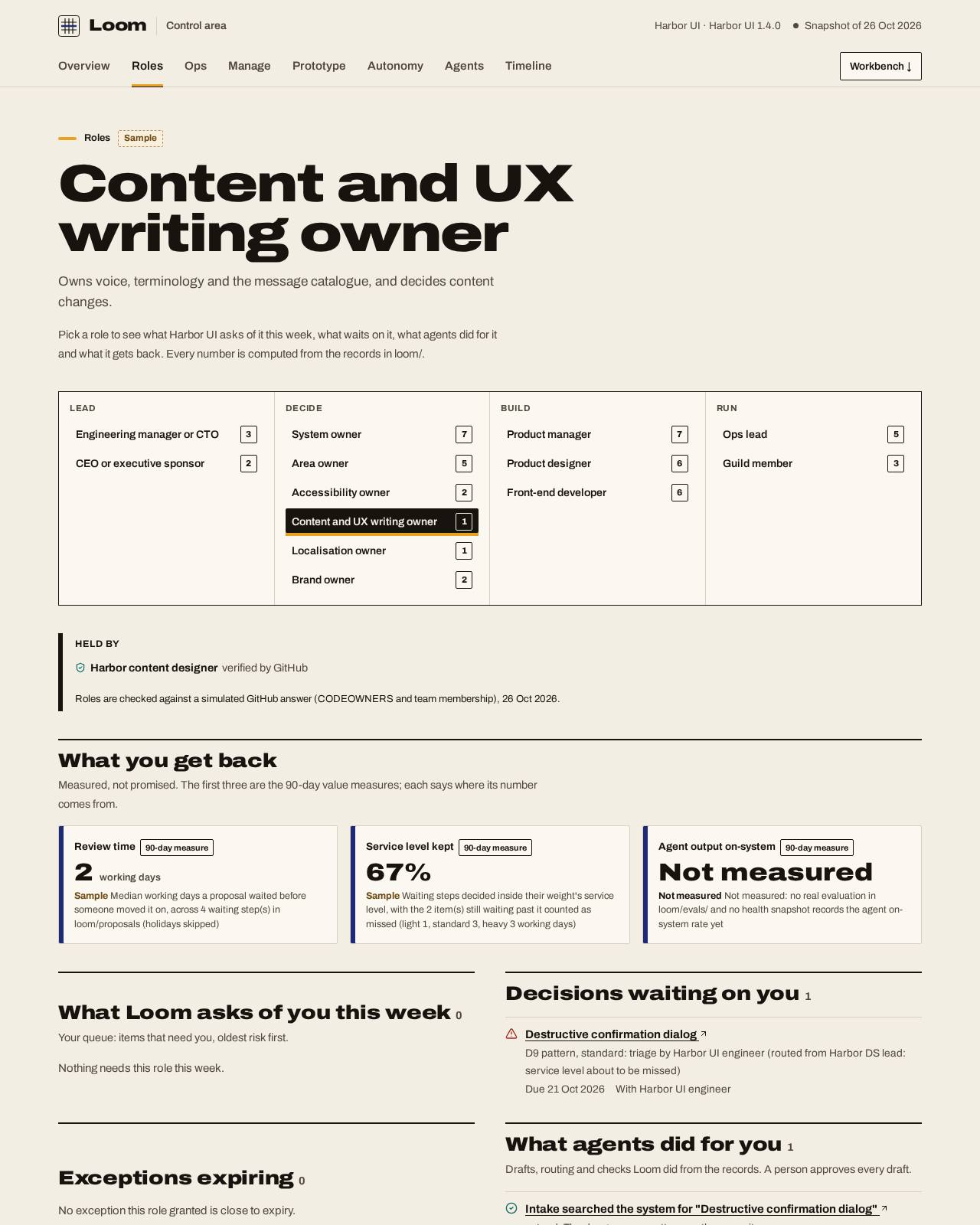
Your guidance becomes something code and agents follow. Loom measures review time, the share of decisions made inside their service level and how much of what agents write passes the system's rules, and says where each number comes from. In the product tour they are sample values; in your organisation they come from your own records.
What you never have to do
You never police copy screen by screen. You never re-explain the same term to every new agent. You never discover a pattern's messages after release.
Coming next
An AI writer that drafts interface copy within your voice rules, and pseudo-localisation runs with per-locale text-expansion checks.