The real pain today
Requests disappear. Your team asks for a component. Nobody knows who owns the request or when there will be an answer, so the team builds its own.
Release notes are written for the system team. You cannot tell which change matters to your roadmap.
Nobody knows what already exists. Your team builds a date picker the system already has, because finding it took longer than building it.
Status reports are opinions. You cannot see whether the system work your plan depends on is on time.
Your week with Loom
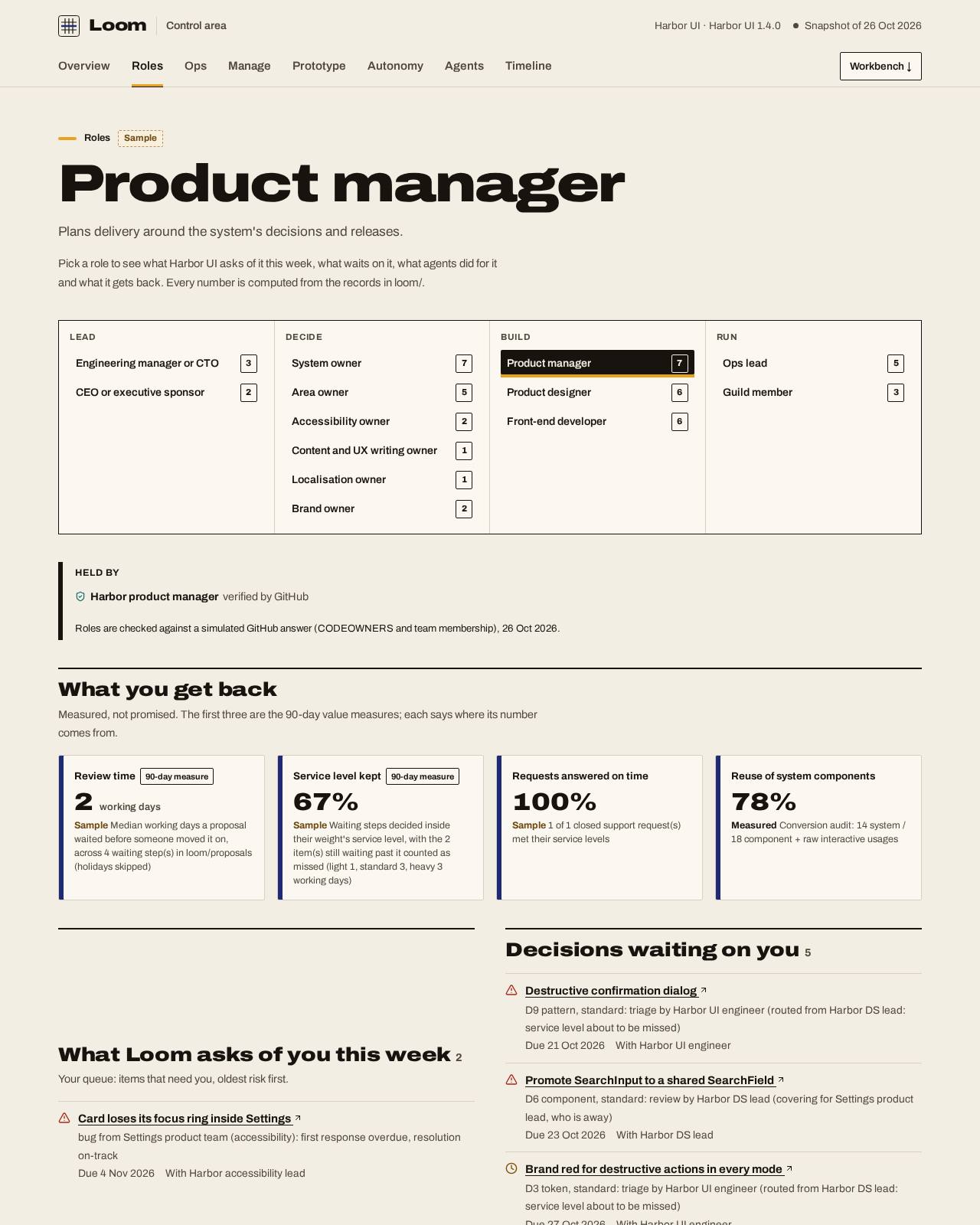
Monday. You open request tracking: every ask your team made to the system team, with its status, its owner and the two-working-day service level in words: met, missed, on track, at risk or overdue. See request tracking Your home in the control area lists the same asks beside the decisions waiting. See the product manager's home
Tuesday. A request about a component sits in the support queue with its first-response and resolution clocks in working days, skipping your organisation's holidays.
Wednesday. Before planning, you search the reuse finder: approved patterns, signed-off flows and stable components, so your team does not build what already exists. Try the reuse finder
Thursday. You read the release notes in roadmap terms: what was released, what is deprecated and by when, and the decisions taken, drafted from the records and approved by the system owner before they go out. Read the release notes
Friday. You read your teams' needs on the needs radar, built from their asks, searches that found nothing, local copies found in code and usage per team, and the system roadmap board that comes from accepted decisions and needs several teams share. See the needs radar See the roadmap board
These views are built and tested on sample systems (the links open Harbor UI, a synthetic system); they have not yet run in a client repository.
What changes
You plan with dates instead of hopes. Loom measures review time in working days, the share of decisions made inside their service level, and the share of requests answered on time, and shows the basis of each. In the product tour these are sample values; in your organisation they come from your own records.
What you never have to do
You never chase a request in chat. You never translate a technical changelog for your stakeholders. You never discover a breaking change in the week it lands: deprecations carry a replacement and a date, and your home lists them.
Coming next
Voting on the roadmap board from the page itself; today a vote is a pull request or a command. Release notes posted to your Slack channel once the Slack bot is installed in your workspace; today it has been tested against a test double of Slack only.