The real pain today
Agents multiply inconsistency. Each agent writes plausible code. Across teams it becomes local copies of the same components, raw values instead of tokens and accessibility gaps.
Rules are not machine-readable. They live in documentation and in people's heads. A linter covers a small part; agents cannot read the rest.
Breaking changes land mid-sprint. A shared component changes and a product team finds out when its build fails.
Access is a blank cheque. New tools ask for broad access to your code and keep your system in their own format.
Your week with Loom
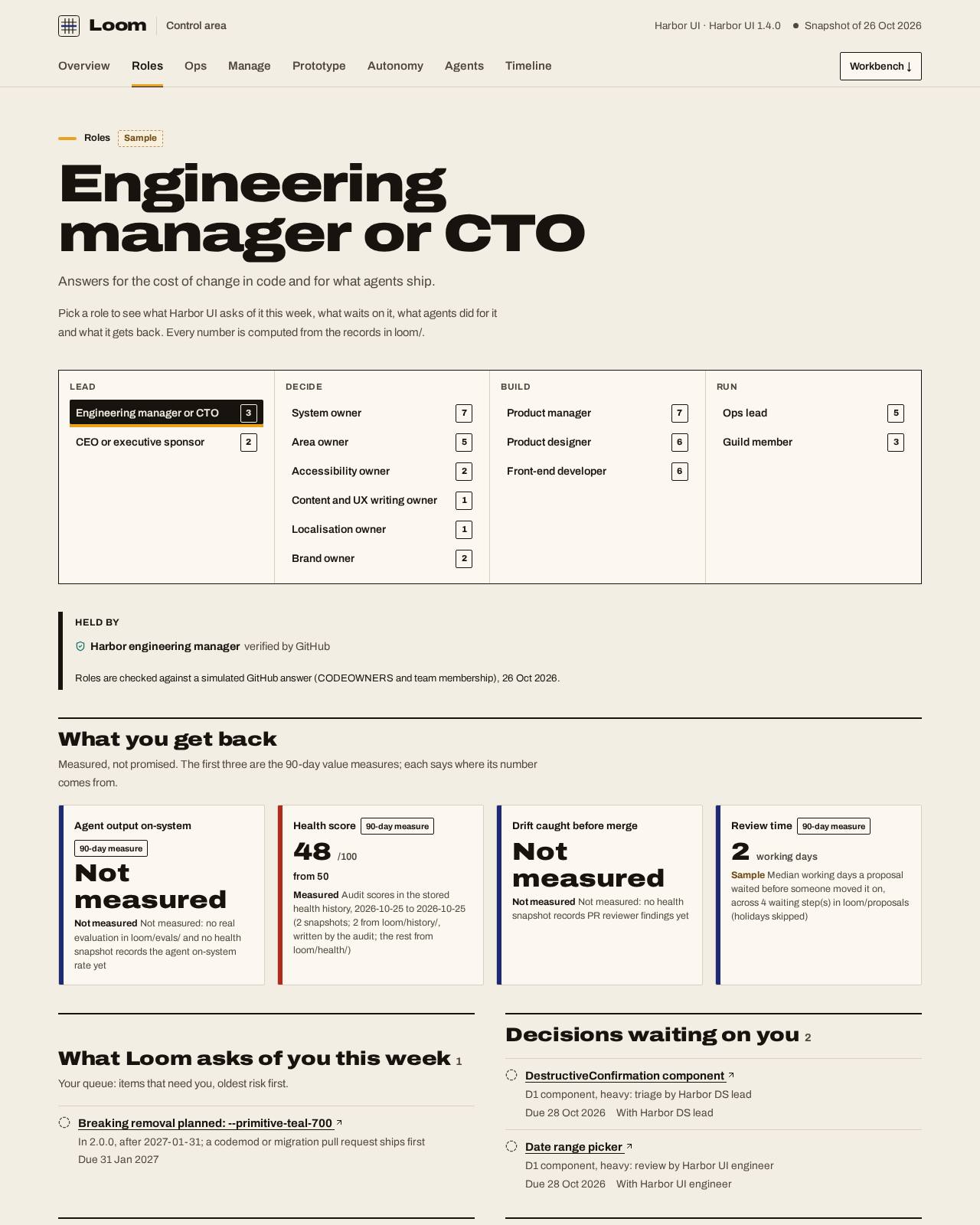
Monday. Your home shows the trend first: the share of agent-written changes that passed your rules, the health score over time and drift caught before merge. See the engineering lead's home
Tuesday. A developer's agent calls Loom's MCP server before writing a screen. It searches the system, gets the real component with its import, and checks the result with check_composition. The same checks run as a command in any CI and fail the build on an error. Watch a recorded agent
Wednesday. A breaking change is proposed. Loom's contract diff classifies it as major, so it is a heavy decision for the system owner and ships only in a scheduled major. The migration simulator says how many call sites the codemod rewrites and how many need a person, and the migration arrives as a draft pull request, built and tested on sample consumers so far. Your home lists each scheduled breaking change and its date.
Thursday. You review who may do what. Roles are records in your repository and are checked against your git host: team membership and CODEOWNERS. A person whose verified identity lacks the role is refused, with the reason. Agents never review, grant exceptions, release, deprecate or change rules. Read who does what
Friday. You look at what agents cost. Every Loom tool call is logged with hashes of its inputs and outputs, never the content, under a per-run budget. Agents run on your own model and keys.
What changes
Agent output becomes something you can measure, not hope about. Loom shows three numbers on your home and says where each comes from: agent output on-system, the health score trend and drift caught before merge. They are the same measures we use to judge an engagement at 90 days. In the product tour they are sample values; in your organisation they come from your own records.
What you never have to do
You never paste the design system into a prompt. You never grant Loom write access to your main branch: Loom writes only to branches named loom/, never merges, and never touches CI configuration or CODEOWNERS. You never ask whether an approver was allowed to approve: the record says, and the host confirms it.
Coming next
Migration pull requests across every consuming repository from one run, and a packaged CI step will replace the command you wire up today. The Loom GitHub App will request organisation "Members: read" so team membership is verified on GitHub itself, once you approve that permission.