The real pain today
Requests disappear. You ask for a component the library does not have. Nobody knows who owns the request, so a team builds its own version and the system gets weaker.
The library and the code disagree. A variant exists in Figma and not in code, or the other way round. You find out at handoff.
Guidance is missing where you need it. You can see what a component looks like, not when it should not be used or what its text should say.
Your week with Loom
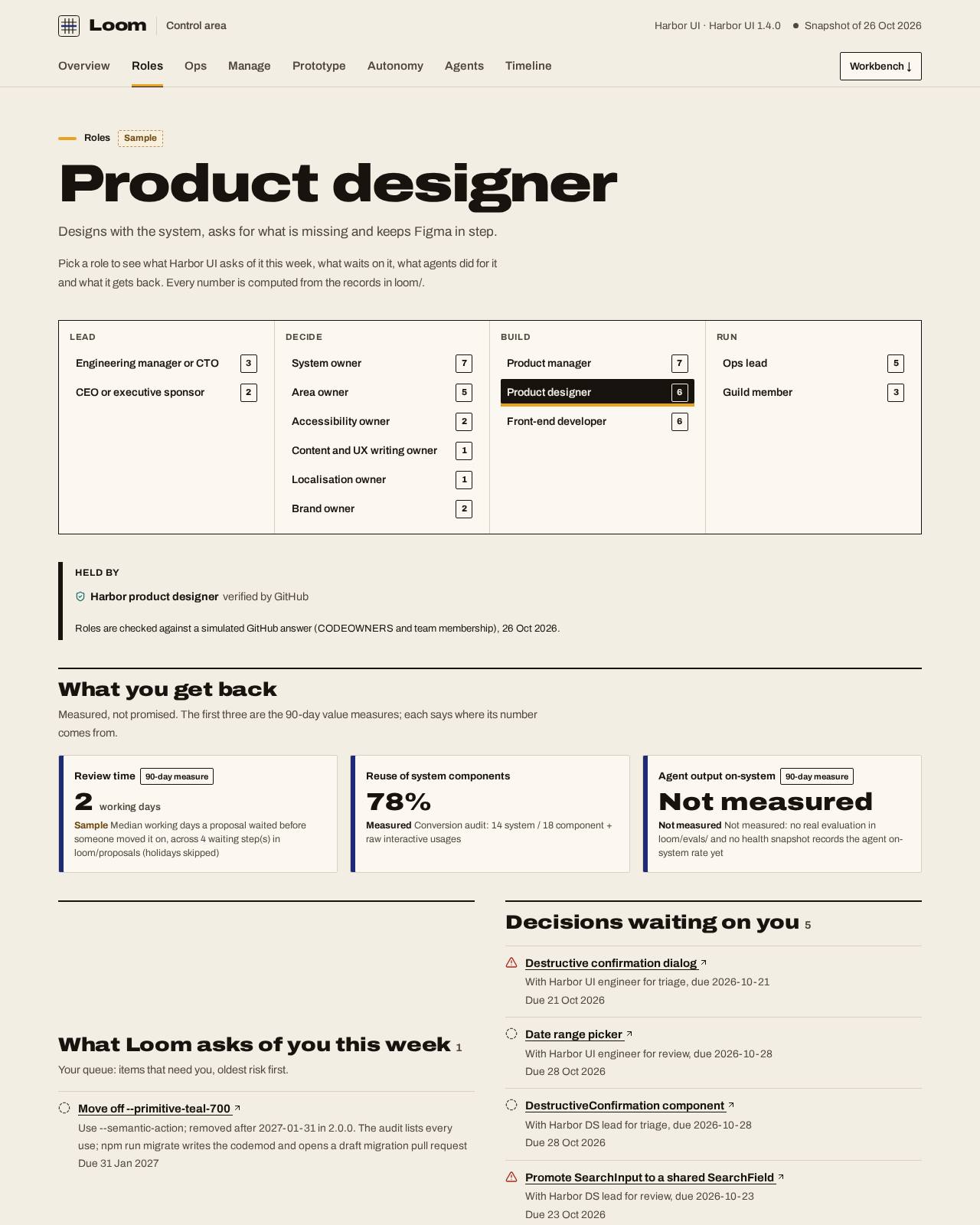
Monday. Your home shows your open asks and where each one is: with which owner, for triage or review, and the due date. See the product designer's home
Tuesday. You need a toggle between monthly and yearly prices. Before you draw anything, intake searches the system and answers reuse, extend or new, with the evidence. When nothing fits, the need is recorded, so the owner sees how often teams ask for the same missing thing.
Wednesday. Your ask is a proposal in the review queue. A light decision such as a new variant goes to the owner of that component family, with a service level in working days. If they are away, their delegate picks it up.
Thursday. You read the component's contract: what it is for, when not to use it and what to use instead, its states and its keyboard behaviour. Content rules, such as preferred terms, are checked in interface copy, not left in a PDF.
Friday. Loom compares the Figma library with the code and lists where they differ: a missing variant, a different value, a component that exists in only one place. By default code is the truth and Figma follows; the area owner decides each difference.
What changes
Your asks stop disappearing. Loom measures review time in working days, the reuse of system components in product code, and how much of what agents build passes the system's rules, and says where each number comes from. In the product tour they are sample values; in your organisation they come from your own records.
What you never have to do
You never ask in three channels and hope. You never rebuild a component that already exists because finding it took too long. You never learn at handoff that the library was out of date.
Coming next
A need that passes the owner's threshold will become a draft proposal on its own. The prototype composer, which today runs for our reference system on a development server, will run for other systems too.